
Tuesday, 11 May 2010 17:00
Coppervale Enterprises Inc. Challenges Western Washington University Students to Research Potential for Sustainable Business Initiatives in International Markets: Part 1
Written by Cristian Bravo
In the last decade there has been substantial growth in interest related to environmentalism and sustainability on the global stage. As each international market adapts to this emerging demand for environmental awareness in business operations, a priority must be placed on first understanding the implications of existing cultural beliefs and norms. In January 2010, Coppervale Enterprises Inc. tasked a group of four students from Western Washington University’s International Business program to develop a market research medium that could effectively help our organization to better understand the business opportunities that exist relating to energy efficiency and sustainability consulting as we expand into global markets. In particular, Coppervale is interested to learn how we can tailor our sustainability services to best suit potential international clients’ needs within their own unique cultural frameworks. The Western business students accepted our challenge and worked for the next three months to design a research methodology to…
Published in
Blog
Most of the Congressional attention in Washington D.C. over the last three months has been directed solely on Health Care Reform. As the dust settles, the Senate Climate Bill will soon emerge as the next landmark decision awaiting the Obama Administration. As opposition to EPA regulatory measures continues to rise and as mid-term elections draw closer, the hope for the passage of a similarly contentious piece of American legislation hangs in the balance. Despite the challenges ahead, the latest news indicates that passage of the Senate Bill could still be a possibility in the coming months. One source of pressure fueling movement on the Senate Climate bill is the EPA’s GHG Endangerment Finding. This ruling requires the Federal agency to regulate GHG emissions in the economy under the authority of the Clean Air Act (CAA). The EPA has come under fire from business lobbyists, the oil industry and conservative senators,…
Published in
Blog
When considering ways to create a more energy efficient work environment, lighting upgrades can be a smart, cost-effective solution that also reduces your company’s carbon footprint without substantial capital investment. Over the past three decades, the lighting industry has seen great advancements. Lighting engineers and designers have been able to improve the overall quality of indoor lighting with lumen output and improved color rendering, while simultaneously achieving an average of 25-40% energy savings in each advancement phase. For example, next generation indoor fluorescent lamps, such as T8 and T5, offer substantial energy-savings over the older T12 models. With the improvements in microchip technology, light emitting diode (LED) products are also finding their way into indoor lighting systems. LEDs present many advantages over incandescent light sources including lower energy consumption, longer lifetime and greater durability. Companies with older facilities have recognized this and are turning to lighting upgrades or “retrofit projects” as…
Published in
Blog
Thursday, 28 January 2010 16:00
Despite Ambitious Commitments, Copenhagen Does Little to Spur on American Policy – Corporate Investments Remain on Hold
Written by Cristian Bravo
In the late evening on December 18th, 2009, all eyes were on Copenhagen waiting to see if the Conference of the Parties 15 (COP15) of the United Nations Framework Convention on Climate Change (UNFCCC) would produce a global climate treaty that would require the nations of the world to reduce their output of greenhouse gas (GHG) emissions. The outcome of COP15 was expected to impact every aspect of society, and most prominently, the corporate world. At the end of a two week long negotiating session, Copenhagen produced a non-binding “agreement” void of any real emissions reduction targets or timetables to achieve them. The Copenhagen Accord was a decision made by the 193 nations participating in the Conference to “take note of” for further review in 2010. The Accord recognizes the following major action items: There is a scientific case for keeping global temperature rise to no more than 2°C. Developed Nations…
Published in
Blog
Tagged under
Tuesday, 19 January 2010 16:00
Corporations and Conservative Politicians Unleash a Backlash Against EPA's GHG Endangerment Finding
Written by Cristian Bravo
On December 7, 2009, the EPA released a statement concluding that greenhouse gases (GHG) threaten public health, welfare, and the environment, and in turn, warrant regulation under the Clean Air Act (CAA). The implications of such a statement will be substantial and far-reaching, as many businesses will soon have to report on and abate their carbon footprints under the EPA’s strict command-and-control regulatory approach. Greenhouse gas legislation has been in the works for over a year now, however this endangerment finding has done more to strike fear into the hearts of business executives far more than the pending cap-and-trade Bill in Congress. The reason for this comes down to the fundamental differences in the way the regulatory regimes designed to reduce greenhouse gas emissions will be implemented. An NPR news report indicates that “Business groups have strongly argued against tackling global warming through the Clean Air Act, saying it is…
Published in
Blog
Tuesday, 22 December 2009 16:00
Why Should a Company Bother to Conduct a Carbon Impact Assessment?
Written by Cristian Bravo
Conventional “business wisdom” suggests that a company can increase its cost savings and improve its bottom line by just becoming more energy efficient. The Cable Television Industry, for example, uses Network and Facility Efficiency Studies as an effective means to identify these opportunities. However, contrary to this belief, a Carbon Impact Assessment can actually help create a more complete picture of the savings possibilities. In fact, it can actually expand a company’s profits in their top line. Here is why conventional “business wisdom” may have gotten it wrong: Using the Cable Television Industry’s Network and Facility Efficiency Studies as an example, one would discover that, by nature, they are inextricably linked to the Carbon Impact Assessment. The purpose of both efforts is to identify types of energy sources, gather data about frequency and degree of consumption, discover areas where inefficiencies dominate, and determine comparative references which articulate those inefficiencies. The primary…
Published in
Blog
Energy Management
Useful Resources
 Presentation: REDUCING SUPPLY SIDE UTILITY COSTS
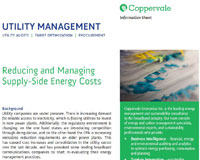 Info Sheet: UTILITY MANAGEMENT
Reducing and Managing Supply-Side Energy Costs.