
Thursday, 12 September 2013 17:00
Finer Points of Greenhouse Gas Goal Setting
Written by Cristian Bravo
Much of the general research about goal setting directs us to believe that reaching for the stars produces the best results (see Locke & Latham, 2002, 2006). Our sustainability consulting team at Coppervale Inc. embraces that perspective. But there’s a catch. Goal setting ought not to be taken lightly. For example, when we consult with clients about setting GHG reduction targets, we use multiple data points, not least of which is one related to the organizations capacity for change. For other sustainability initiatives, we even advise that goal setting may even erode progress. If you remember from the previous blog, our fictional, recently hired Sustainability Manager was in the process of making a recommendation to the CFO regarding a GHG reduction goal for the organization. Right before leaving the office she remembered an article that she’d read in graduate school titled “Goals Gone Wild: The Systematic Side Effects of Over-Prescribing…
Published in
Blog
Tagged under
Saturday, 03 August 2013 17:00
Setting Green House Gas Targets for your Enterprise (Is not Easy)
Written by Cristian Bravo
This is the first of three blogs regarding setting Green House Gas (GHG) reduction targets. It begins with a common situation. It’s your first week as the newly minted Sustainability Manager for a fast growing mid-size company and the CFO sends you a one-liner via email - “GHG reduction target – recommendation?...need soon” You’re smart and senior enough to instantly recognize that this is a fairly complex topic that includes a bit of art but also a strong dose of science. Given that, you work to buy yourself a couple of days before you respond so that you can brush up on the recent literature. The first lesson you note is the difference between an absolute target and one based on operational intensity like revenue or units sold. While the difference is basic you sense that the implications are immense regarding the way your company would go about meeting…
Published in
Blog
Tagged under
Tuesday, 27 November 2012 16:00
Report Highlights Global Business Opportunities in Advancing Sustainability Practices
Written by Cristian Bravo
This year the United Nations Conference on Sustainable Development (Rio+20) met in Rio, Brazil. At the conference, the UN Secretary-General Ban Ki-moon highlighted a global initiative launched late 2011 that focused on achieving Sustainable Energy for All. The initiative calls on private sector and national participation to meet three energy objectives by 2030 - energy access, energy efficiency and a focus on renewables. In the wake of this conference, a new report has been released by the United Nations Global Compact and Accenture, titled “Sustainable Energy for All: The Business Opportunity.” The report, while focused globally, highlights industry specific opportunities and trends. It reports that of industry CEO’s surveyed, 91% will employ energy efficiency measures to address sustainability issues over the next five years. This correlates broadly with consumer perceptions which also indicate a growing trend in renewable awareness and efficiency, with 79% of consumers worldwide reporting a more…
Published in
Blog
Tagged under
Tuesday, 13 November 2012 16:00
An Introduction to Sustainable and Responsible Investing
Written by Cristian Bravo
Sustainable and responsible investing (SRI) is a fairly recent phenomenon that is growing in popularity. This approach to investing now encompasses an estimated 12% of the total investment in the U.S. market place. However, many in the public do not yet kow what SRi is and why it is important. The forum for Sustainable and responsible Investment provides a brief summary on the subject. What is it? SRI recognizes that corporate responsibility and societal concerns are valid parts of investment decisions considering both the needs for returns as well as an investment's impact on society. This encourages corporations to improve thier environmental, social and governance practices. Those who participate in SRI can be individuals, institutions, universities, foundations, pension funds and anyone else who wishes to invest. What is the approach? SRI uses a screening process to evaluate investment worthiness. Both positive and negative screens are used. Positive screens search…
Published in
Blog
Tagged under
Wednesday, 07 November 2012 16:00
Does it matter? Seven trends provide insight on investor views on sustainability
Written by Cristian Bravo
A PricewaterhouseCoopers article, "Do Investors Care About Sustainability? Seven Trends Provide Clues" gives an overview on whether the sustainability of a company impacts investment decisions. Seven trends in finance are examined to provide a basis for the ansewer to the question: Does it matter? Below is a short summary of each trend. 1. Susainability shareholder resolutions are gaining traction: Investors are coming together and voicing concern about climate change and its effect on business. Many investor groups are also lobbying for governments worldwide to adopt international climate change treaties. 2. Steady growth in sustainable investment: One out of every eight dollars under professional management in the US is in sustainable and responsible investing according to the Social Investment Forum Foundation. 3. Positive relationships between environment, social governance factors and financial performance: Those who participate in environmental and social stewardship are seeing benifits in stock performance, lower volatility and other…
Published in
Blog
Tuesday, 30 October 2012 17:00
Fleet Fuel Costs and Carbon Emissions: Alternative Fuel Vehicles are a Win-Win
Written by Cristian Bravo
For those on either side of the political debate on climate change, the economics of reducing emissions is beginning to make good financial sense. Market realities, high fuel costs, and decreasing costs of alternative fuel vehicles, are all contributing to an environment where by conversion to alternative fuel vehicles (AFV) is becoming increasingly attractive. Add to the mix U.S. tax credits up to $7,500 per vehicle, and the numbers start to add up. SunRidge Farms, a snack food maker in Royal Oaks California recently told Jennifer Wang of Entrepenuer.com, “We save 33 percent on fuel costs off the hybrids alone.” SunRidge began conversion to an alternative fuel fleet in 2004, as part of an overall sustainability strategy. Conversion to AFV typically reduces fuel consumption, which immediately reduces fuel costs. In addition to this, switching to alternative fuels such as electric or compressed natural gas (CNG) also reduces carbon emissions.…
Published in
Blog
Tagged under
Energy Management
Useful Resources
 Presentation: REDUCING SUPPLY SIDE UTILITY COSTS
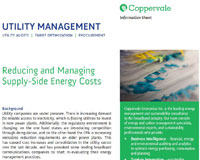 Info Sheet: UTILITY MANAGEMENT
Reducing and Managing Supply-Side Energy Costs.