

Cristian Bravo
Aenean nonummy hendrerit mauris. Phasellus porta. Fusce suscipit varius mi. Cum sociis natoque penatibus et magnis dis parturient
Website URL: http://vtem.net
Tuesday, 19 January 2010 16:00
Corporations and Conservative Politicians Unleash a Backlash Against EPA's GHG Endangerment Finding
On December 7, 2009, the EPA released a statement concluding that greenhouse gases (GHG) threaten public health, welfare, and the environment, and in turn, warrant regulation under the Clean Air Act (CAA). The implications of such a statement will be substantial and far-reaching, as many businesses will soon have to report on and abate their carbon footprints under the EPA’s strict command-and-control regulatory approach.
Greenhouse gas legislation has been in the works for over a year now, however this endangerment finding has done more to strike fear into the hearts of business executives far more than the pending cap-and-trade Bill in Congress. The reason for this comes down to the fundamental differences in the way the regulatory regimes designed to reduce greenhouse gas emissions will be implemented. An NPR news report indicates that “Business groups have strongly argued against tackling global warming through the Clean Air Act, saying it is less flexible and more costly than the cap-and-trade bill being considered before Congress.” (NPR, 2009). The command-and-control regulatory approach under the CAA tends to be a more expensive measure for businesses because it involves a “one-size fits all approach” where the EPA will step in and recommend Best Available Control Technologies (BACT). These technologies typically involve expensive upgrades or retrofits that do not take into consideration other methods that may be more appropriate for the corporation.
The cap-and-trade market-based approach is favored by economists and corporations alike because it allows for more flexibility in implementation. A cap on emissions is determined at the Congressional level, polluters are required to purchase permits, or “allowances” if they are given away for free, to emit greenhouse gases in their operations. Under such a scheme, corporations will have an incentive to reduce their carbon footprint in order to sell their excess permits to those corporations unable or unwilling to reduce their emissions. The cap-and-trade method allows for money to be made, and hopefully, more efficiency measures to be established.
In the time since the EPA’s announcement, numerous business and conservative political groups have been gathering steam in their opposition to the ruling. On December 24th, 2009, the National Cattleman’s Beef Association filed a petition to the rule in the DC Circuit Court of Appeals, citing that “…increased energy costs associated with this ruling will be devastating for agriculture and the public as a whole.” (NCBA, 2009). Earlier in November 2009, the Republican Governor of Texas, Rick Perry, issued a statement to EPA urging that a proposed framework for regulating greenhouse gases be avoided due to its “devastating implications for Texas’ economy and energy industry” (Office of the Governor, Rick Perry, 2009). On January 20, 2010, U.S. Sen. Lisa Murkowski (R-Alaska) is expected to “shut down”the GHG ruling by “seeking an amendment to an unrelated debt bill… or will seek a resolution of disapproval, which would not be subject to filibuster” (Environmental Leader, 2010).
We have yet to see what will come out of this opposition. The good news for corporations is that the EPA ruling has done much to spur talk on the movement of the GHG legislation pending in Congress. For now though, the status of GHG legislation is at a standstill. After a failure at Copenhagen by the world’s nations to reach an agreement on a global climate accord, opinions in the U.S. are that current GHG legislation will suffer a similar fate. Congressional committees have been established to combine elements of the Waxman-Markey House Bill and the Kerry-Boxer Senate Bill to be re-voted on in the House and Senate in the first quarter of 2010. Pundits suggest that if a decision is not made before April 2010, the U.S. should not expect a climate bill to be passed this year, as attention will be focused on the mid-term elections.
Hold on to your hats, this could be a bumpy ride…
Published in
Blog
Tagged under
Tuesday, 22 December 2009 16:00
Why Should a Company Bother to Conduct a Carbon Impact Assessment?
Conventional “business wisdom” suggests that a company can increase its cost savings and improve its bottom line by just becoming more energy efficient. The Cable Television Industry, for example, uses Network and Facility Efficiency Studies as an effective means to identify these opportunities. However, contrary to this belief, a Carbon Impact Assessment can actually help create a more complete picture of the savings possibilities. In fact, it can actually expand a company’s profits in their top line. Here is why conventional “business wisdom” may have gotten it wrong:
Using the Cable Television Industry’s Network and Facility Efficiency Studies as an example, one would discover that, by nature, they are inextricably linked to the Carbon Impact Assessment. The purpose of both efforts is to identify types of energy sources, gather data about frequency and degree of consumption, discover areas where inefficiencies dominate, and determine comparative references which articulate those inefficiencies. The primary difference between the Network and Facility Studies and the Carbon Impact Assessment is that energy efficiency is articulated in terms of cost, rather than carbon emissions. The same information needs to be generated to calculate either reference. Therefore, the example CATV company is already doing 80% of the work needed to create a Carbon Impact Assessment when they conduct the Network and Facility Studies. The marginal cost of completing the extra 20% is worth the added benefit the CATV company will receive should it choose to complete the Carbon Impact Assessment.
A major benefit to the CATV industry, as well as all other industries, is that the company performing the Carbon Impact Assessment will have a clearer knowledge and awareness of all of their associated emissions across their entire operation. Their knowledge base for energy savings will not be limited to only the facility, network, or transportation sector, for example. Another major benefit is that it will further improve a company’s “top line” by increasing the competitiveness of their business in a more environmentally-aware marketplace. We are in the “Age of Accountability”. Our interdependent and wired world has changed the market landscape to one where consumers are more aware and educated about the operations of the businesses they patronize. According to Andrew Savitz and Karl Weber, authors of The Triple Bottom Line: How Today’s Best-Run Companies are Achieving Economic, Social and Environmental Success, “Transparency is increasing just as corporate reputation, brands, and other intangible assets are becoming dominant value drivers” 1. Conducting a Carbon Impact Assessment serves to add to a company’s transparency and “green” reputation. These “intangible assets” associated with this exercise are only net positives for an organization. The active efforts taken by an organization to improve energy efficiency for both their network and facility operations will lead to immediate and recognizable reductions in carbon emissions in addition to cost savings. Communicating these successes effectively will help the company build brand loyalty and gain new customers.
The true opportunity for all companies is to adopt a holistic approach that goes beyond the sole recognition of the traditional financial impact to the bottom line. The Carbon Impact Assessment will add to the credibility of a company’s green image by addressing the financial bottom and top lines, as well as the environmental and social bottom lines identified in The Triple Bottom Line. The question now is, “Why wouldn’t a company want to conduct a Carbon Impact Assessment?”
1Savitz, Andrew W., and Karl Weber. The Triple Bottom Line: How Today's Best-Run Companies Are Achieving Economic, Social, and Environmental Success - And How You Can Too. San Francisco: Jossey-Bass, 2006. Print.
Published in
Blog
Tagged under
Monday, 05 October 2009 17:00
No regulation without legislation!
This is what the Chamber of Commerce is chanting lately. The National Association of Manufacturers is threatening to sue. Yet the Environmental Protection Agency has announced that if Congress won’t legislate to cut green-house gases, they will regulate.
The EPA’s announcement is the ace Obama’s administration has been holding in its pocket, an ace that may trump the US’s attempts to control carbon emissions. A Supreme Court decision earlier this year has empowered the EPA to assert that CO2 is a pollutant, and as such must be regulated from vehicles. Now, the administration has authorized the agency to start regulating GHG’s from power stations and industry, the backbone of the US economy. "We are not going to continue with business as usual," said Lisa Jackson, EPA’s chief, to the New York Times. “We have the tools and the technology to move forward today, and we are using them."
The new rules would cover plants that emit at least 25,000 tons of carbon dioxide a year. The regulation primarily focuses on 400 power plants, which will suffer fines if they fail to utilize the cleanest available technology. In addition to the power plants, another 14,000 or so facilities and smaller power plants will also face the threat of fines, and would need to renew construction and operating permits based on their ability to cut their emission of carbon dioxide, methane, nitrous oxide, and other GHG.
The rules could take effect as soon as 2011, unless Congress legislates. "The Economist" argues that businesses would prefer the carrot of a cap-and-trade legislation to the stick of government regulators nosing around their plants and telling them what technologies to use.
Senators John Kerry and Barbara Boxer have stepped up and published their own version of the cap-and-trade bill previously know as Waxman-Markey. They upped the ante by proposing a 20% GHG reduction by 2020 over 2005, rather then the 17% previously proposed.
The stakes are high and the battle over them is turning fierce. The Chamber of Commerce is opposing cap-and-trade, stating that corporations do not need to pay for the right to emit carbon. According to the "WSJ," that was enough for giants such as PG&E, Exelon and Nike to resign their membership and weaken one of the best funded opponents of climate legislation.
Suddenly, “no regulation without legislation” is beginning to sound climate friendly.
David Manor
Published in
Blog
Tagged under
Tuesday, 25 September 2012 17:00
Ryder Releases 2011 Corporate Sustainability Report
Today, Ryder System, Inc. released its 2011 Corporate Sustainability report titled “Making Commerce Flow More Efficiently and Sustainably, for Everyone.” Their third report since 2008 outlines steps and achievements taken by Ryder in the development and execution of their sustainability strategy. Highlights from the report include figures developed using methodology from the Carbon Disclosure Project.
The Carbon Disclosure Project is an independent not-for profit organization working to drive greenhouse gas emissions reductions. Their reporting system is divided into three “Scopes.” Scope 1 covers direct emissions for all operations owned and controlled by Ryder. Scope 2 covers indirect emissions for purchased electricity, while Scope 3 covers indirect emissions associated with employee business travel.
Ryder reports 2011 enterprise emissions for the U.S. and Canada’s Scope 1 & 2 at 459,452 metric tons of CO2 equivalent,; down by 7,410 MT in 2010; and by 14,482 MT in 2009. Much of these carbon reduction gains came from a 3.1% reduction in energy use at Ryder facilities. Ryder’s Scope 3 emissions for the U.S. and Canada reported 18,838 MT in 2011, up by 3,913 MT in 2010, their first year of reporting Scope 3 emissions. Ryder explains the increase is due to an expansion in the scope of the data capture to include employee use of rental cars in their CO2e in 2011.
Ryder provides transportation and logistics solutions. In 2011 they posted revenue of 6.05 billion dollars, employed 27,500 employees globally, and had 807 fleet management operating locations across the globe. Their fleet composed of 121,000 full service lease vehicles; 35,300 contract maintenance vehicles; and 39,000 rental vehicles.
Photo credit: idreamofdaylight via Flickr CC
Published in
Corporate Sustainability
Tagged under
Tuesday, 03 December 2013 00:00
Stakeholder Engagement

Ensuring your employees understand your sustainability allows for more coordinated actions. We offer communication planning, message development and internal brand campaign design to deliver critical information to your staff that raises awareness and builds excitement about your sustainability program...
Published in
Sustainability Consulting
Tagged under
Tuesday, 03 December 2013 00:00
Public Disclosure

For companies that recognize the importance of reputation management, reporting environmental information through leading disclosure channels and 3rd party organizations can improve public perception...
Published in
Sustainability Consulting
Tagged under
Tuesday, 03 December 2013 00:00
Carbon Abatement
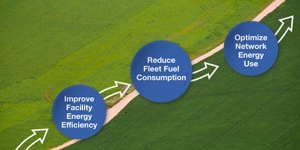
Uncover your best opportunities. Acting as a roadmap, the Carbon Abatement Plan can help steer you through the challenges of understanding where inefficiencies are prominent and what operational areas are responsible for the breakdowns in efficiency at your company...
Published in
Carbon Management
Tagged under
Tuesday, 03 December 2013 00:00
Carbon Auditing

Know where you stand. The carbon audit is the principle accounting tool that maps energy usage and associated carbon emissions across your company’s operational footprint. Coppervale uses the World Resources Institute Greenhouse Gas (GHG) Protocol Corporate Accounting and Reporting Standard....
Published in
Carbon Management
Tagged under
Tuesday, 03 December 2013 00:00
Carbon Management

Energy and Carbon are different sides of the same coin. Energy inputs in business operations result in corresponding outputs of carbon emissions. Inefficient operations create energy waste, unnecessary costs and excess emissions....
Published in
Carbon Management
Tagged under
Tuesday, 03 December 2013 00:00
Sustainability Strategy

Coppervale believes sustainability is one of the most critical issues today. Organizations are faced with ongoing pressures and uncertainty due to a struggling economy, a dynamic legislative and regulatory environment, and increasing demand for environmental disclosure from media...
Published in
Sustainability Consulting
Tagged under